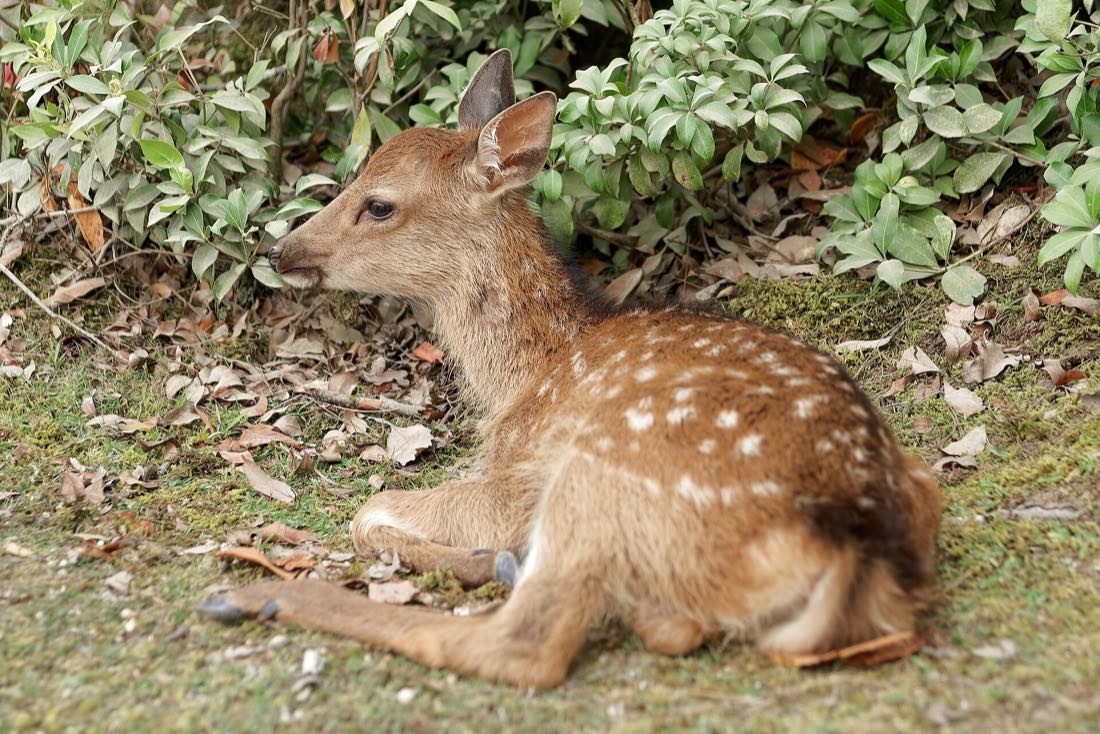
The deer:
not Nara, not tame,
and after your map.
Miyajima's deer are the island's second most photographed thing and the most misunderstood. Feeding has been banned since 2008, nobody sells crackers, they do not bow, and they have learned that tourists carry paper. Worth ten minutes of your day and a zipped bag.
They are free, they are everywhere near the pier and the promenade, and they are not what the internet has told you. Feeding has been illegal on Miyajima since 2008, no vendor sells deer crackers, and the deer do not bow — that is Nara, 350km away, and a different arrangement entirely. What Miyajima's deer have learned instead is that visitors carry paper, so maps, ferry tickets, guidebooks and paper bags all go regularly. Enjoy them for ten minutes, zip your bag, and do not plan a day around them.
Hungry, not aggressive — and that distinction matters
The honest versionMiyajima's deer aren't aggressive, they're hungry. Feeding has been banned since 2008, so they've learned to eat paper — maps, tickets, guidebooks. They don't bow like Nara's and they aren't fed crackers. They look thin because they are; the island stopped the feeding and hasn't fully solved what comes next.
That last sentence is the part other pages leave out, so here it is once, plainly: the deer look thin because they are, and the island has not fully solved what comes after the feeding ban. Stopping the feeding in 2008 was the right call — a population fed on crackers and crisps by several million visitors a year is not a healthy one — but a herd that spent decades learning to get food from humans does not unlearn it because a sign went up. What you are looking at on the promenade is an animal in the middle of that transition, and it is worth knowing before you photograph it.
The practical consequence is paper. Deer nose into open bags, take maps out of back pockets and will pull a paper carrier bag straight out of a hand. It is not aggression and there is very little risk of being hurt; it is a large ungulate doing the one thing that has historically worked. Ferry tickets are the expensive version of this mistake — keep yours zipped away, not in a hand or a hip pocket.
They are also smaller than Nara's, and there is no bowing behaviour. Nara's deer bow because they have been conditioned by decades of cracker vendors to perform for food; there are no vendors here, so there is no performance. If you have seen a video of a deer bowing in Japan, you have seen Nara.
Where you will meet them: the pier, the promenade in front of the shrine, the grassy stretch by the sea and the lower slopes towards Momijidani. They thin out with altitude — a Mount Misen climb is mostly deer-free above about 200m.
Miyajima deer and Nara deer are not the same animal
ComparedThis is the single most common misconception about the island, and it changes what you should do.
| Miyajima | Nara | |
|---|---|---|
| Feeding | Banned since 2008 | Encouraged — crackers sold at licensed stalls |
| Deer crackers for sale | No | Yes, at stalls throughout the park |
| Bowing | No — no conditioning, no vendors | Yes, learned for food |
| Size | Noticeably smaller | Larger |
| What they go for | Paper — maps, tickets, guidebooks, paper bags | The crackers in your hand |
| Condition | Visibly lean; the post-ban transition is not finished | Well fed, in some cases over-fed |
| What you should do | Zip your bag and keep paper out of sight | Buy crackers or keep your hands empty |
| Verdict | DEPENDS | DEPENDS |
If your reason for visiting Japan includes feeding deer, that is Nara and not Miyajima. Coming here for it is the one deer-related mistake worth actively preventing.
Four rules that cover every deer problem on the island
In practiceIt has been banned since 2008 and the ban is the reason the population is being managed at all. Human food — including crisps, bread and sandwich crusts — is worse for them than nothing.
Banned since 2008Maps, ferry tickets, guidebooks, paper bags and receipts all get eaten. Your ¥300 ferry ticket is the one that costs you a queue at the terminal to replace.
¥300 to replace a ferry ticketThey are wild animals with antlers in season and they are used to people, not fond of them. Stand still and let them come past you; that is how the good photographs happen anyway.
Eating anago-meshi or a momiji manju on a bench in front of the shrine is an invitation. Use the seating areas away from the waterfront, or eat inside — the food page has the where.
Deer, quickly
The practical bitdoes not fill a day.
The island does.
The deer are the part of Miyajima children remember and the part that takes the least time. What actually holds a family day together is the ferry, the walk out to the gate on a low tide, the ropeway and a plate of something fried on Omotesando. Family-friendly activities across the Hiroshima area are listed on GetYourGuide — prices and ratings are not published here because we could not verify them.
See family activitiesDeer questions
FAQPage schema pairedCan you feed the deer on Miyajima?
No. Feeding has been banned since 2008, no vendor sells deer crackers anywhere on the island, and human food is bad for them. This is the main difference from Nara, where feeding is an organised part of the experience.
Do Miyajima's deer bow?
No. Bowing is learned behaviour from decades of cracker vendors in Nara, 350km away. With no feeding permitted here since 2008 there is nothing to perform for, so what you get instead is a deer walking straight up to check your bag for paper.
Are the deer on Miyajima dangerous?
Not really — there is very little risk of injury and no history of it being a serious problem, but they are wild animals and males have antlers in season. The realistic cost of an encounter is a chewed map or a ¥300 ferry ticket you now have to queue to replace.
Why do the deer eat paper?
Because it is the closest thing to food that tourists reliably hold. With feeding banned since 2008 they have generalised from crackers to anything carried in a hand, and paper is the most common of those. Guidebooks, tickets, maps and paper bags all go.
Why do the deer look thin?
Because they are. Feeding was banned in 2008 — the right decision for a herd kept on visitor snacks for decades — but the island has not fully solved what replaces it, and the animals within 500m of the pier are in the middle of that adjustment. It is uncomfortable and it is worth knowing.
Where are the deer on Miyajima?
Mostly within 500 metres of the ferry pier — the promenade, the seafront grass and the streets behind the shrine — plus the lower slopes towards Momijidani. Above about 200m on Mount Misen you will not see them at all.
Is the Miyajima aquarium worth adding for children?
It is ¥1,420 for an adult, open 9:00–17:00 with last admission at 16:00, and it is a ten-minute walk beyond the shrine — a reasonable hour if the weather has turned. ⚠ Check your dates first: it is closed from 1 December 2026 to 31 March 2027, which covers the whole of the peak oyster season.
Should I bring my children to see the deer?
Yes, with a zipped bag and one rule: do not chase or corner them. 10 minutes on the promenade covers it. The deer are not a destination, and a family day still needs the ¥200 ferry, the walk out to the gate below 100cm of tide and something fried on Omotesandō.