The best argument against
the four-hour
Hiroshima day trip
Hiroshima has one dish everyone has heard of, one that only exists for five months of the year, and three that barely appear in English at all. The day-tripper eats none of them, because the 16:30 shinkansen leaves before dinner service starts.
Eat okonomiyaki at a standalone counter — ¥960 at Micchan Sōhonten, about $6 — not in the stacked-stall building; add oysters at ¥400–600 a pair if you are here between October and March; and take the ferry-side anago-meshi, ¥2,500–3,000, on a Miyajima day. That is the whole city in three plates, and it costs you one evening you were probably not planning to spend here. ⚠️ The two counters everyone names close on Tuesdays.
What Hiroshima is actually good at
Answer firstFood. Specifically: a griddle dish that is built in layers rather than stirred, the majority of Japan's farmed oysters, a chilled chilli noodle style that almost no English-language guide covers, and a brewery town twenty-five minutes down the line. None of it is refined and none of it is expensive by Japanese standards. All of it is genuinely local, and none of it is available to somebody who arrives at 10:00 and leaves at 16:00.
Hiroshima is a comfortable, well-run, entirely ordinary mid-size Japanese city. The bomb took the old fabric and the rebuild was practical rather than picturesque. Come for the Peace Park, the island and the food — not for the streetscapes. The mistake almost everyone makes is giving the important part four hours and the ordinary part none.
That last sentence is the whole reason this section exists. The Peace Memorial Museum is the reason you came and it deserves two to three hours of your attention. The food is the reason you stay the night — and staying the night is what turns a grim, rushed, emotionally flattening day into a trip. Read how many days you actually need if you have not booked yet.
The seven things to eat, in order
RankedOkonomiyaki, Hiroshima-style
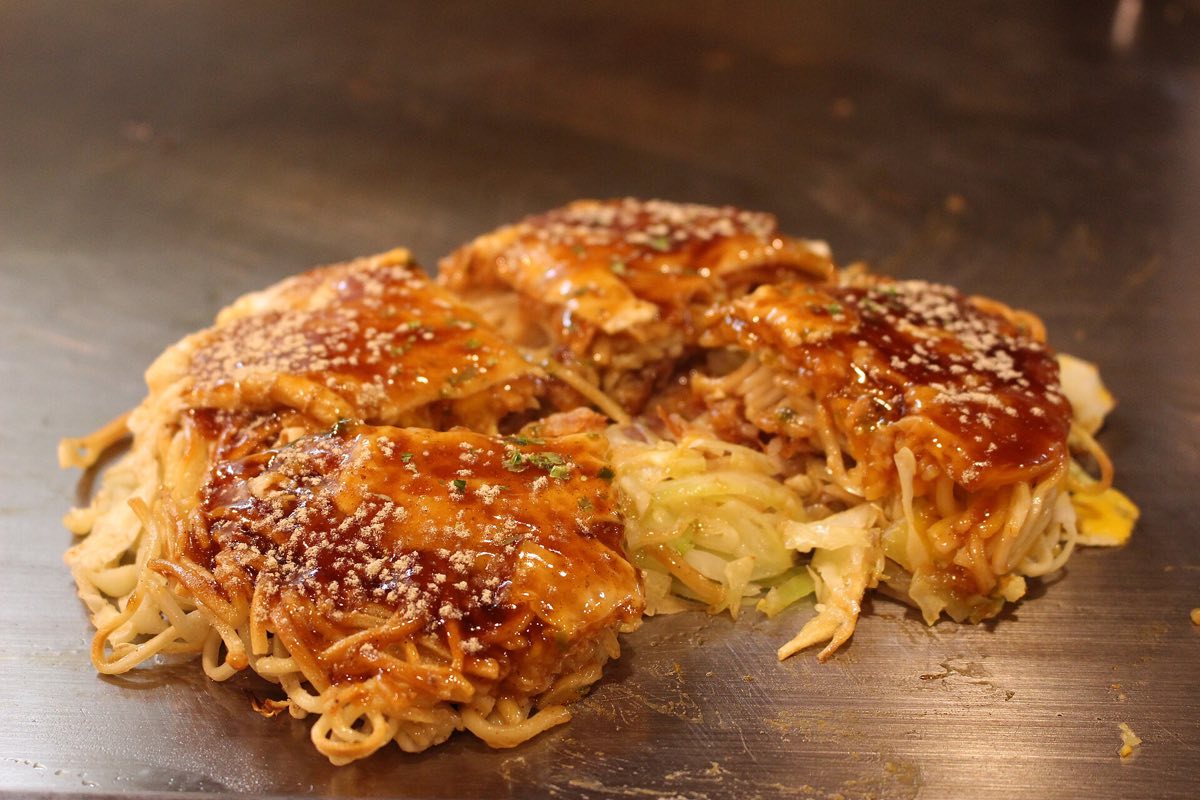
The defining dish and the only one that is on all year. A thin crêpe, a mound of cabbage steamed under it, pork belly, a nest of fried noodles and a sheet of egg — a stack, not a mixture, and that structural difference is the whole distinction from the Kansai version. Micchan Sōhonten prices soba and udon builds identically at ¥960, which tells you the noodle choice is a real either/or. The build order and where to eat it.
Hiroshima oysters
Hiroshima oysters are a winter dish — roughly October to March, peaking December to February. Come in July and you'll find the farmed summer Kaki Komachi variety and a lot of restaurants simply not doing oysters. The grilled-oyster stalls and the festivals are a November-to-March thing. Grilled at a Miyajima stall they run about ¥400–600 a pair. 🔴 And the February 2026 Miyajima Oyster Festival was cancelled for lack of oysters — almost every travel site still lists it as an annual fixture. Season, summer varieties and the festival correction.
Anago-meshi — conger eel over rice
Grilled saltwater eel fanned over rice cooked in the eel bones' stock, sold at Miyajimaguchi since 1901 — which makes it the easiest food upgrade on the trip, because you are already standing at that ferry terminal. ⭐ The finding: pre-ordering the bento does not skip the queue — Ueno's own site says pre-orders and walk-ins share one line. Reserve for the food, not the wait. Hours, the sell-out risk and the backups.
Saijō sake
One of Japan's three great sake towns, with seven or eight breweries within five minutes' walk of the station. 🔴 Take the JR Sanyo Main Line to Saijō — the Shinkansen stop called "Higashi-Hiroshima" is a different station kilometres away. Kamotsuru's hall is free to enter with a ¥500 cash-only three-sake tasting. The festival date and the navigation trap.
Hiroshima tsukemen
The opposite of tsukemen anywhere else: cold noodles dipped into a cold, thin, spicy-sour sauce of soy, dashi, rice vinegar and chilli oil, originally called reimen. 🔥 The spice scales are not standardised between shops — Bakudanya level 3 is roughly Reimenya's "normal" and roughly King-Ken level 1. Order two levels lower than you think. The shops and the scales.
Momiji manju, and the fried version
Maple-leaf castella sponge filled with red bean, born on Miyajima — the leaf refers to Momijidani. About ¥130–200 a piece; boxed, Nishikidō's 5-piece is ¥780 and its chewy mochi-textured nama-momiji 6-piece is ¥1,060. ⭐ Momijidō created and trademarks Age-momiji® — battered and deep-fried to order on a skewer, invented in 2002 as a walking snack. Where to buy it on the island.
Okonomimura, the stacked-stall building
23 okonomiyaki stalls across floors 2 to 4 of one building in Shintenchi, per the prefecture's own tourism board — which pointedly declines to publish building-wide hours. It scores 4.1 from 1,058 TripAdvisor reviews, the weakest among the sights every listicle pushes hardest, and one review is titled simply "Okonomimura: Tourist trap". Go for the spectacle, not the best plate. The honest verdict.
The signature dishes, side by side
ComparedSeason is the column that decides your trip. Everything else is preference.
| Dish | What it actually is | Price | Season | Where | Verdict |
|---|---|---|---|---|---|
| Okonomiyaki | A stack, not a mixture: crêpe, cabbage, pork, noodles, egg sheet | ¥960 at Micchan · ¥1,000–1,999 at Nagataya | All year | Standalone counters · both close Tuesdays | WORTH IT |
| Oysters | Grilled, fried, raw, in miso — Hiroshima grows most of Japan's | ¥400–600 a pair at stalls · sets ¥1,500–3,000 | Peak Dec–Feb, broadly Oct–Mar | Miyajima Omotesandō, city izakaya | DEPENDS |
| Anago-meshi | Grilled conger eel over stock-cooked rice | ¥2,500–3,000 | All year | Ueno, 1 min from Miyajimaguchi Station | WORTH IT |
| Tsukemen | Cold noodles, cold spicy-sour dip, piled raw cabbage | ¥900–1,300 | All year, best in summer | Bakudanya at ekie and Heiwa Kōen-mae | WORTH IT |
| Saijō sake | Brewery town, 5 min walk from the station | Rail under ¥700 each way · Kamotsuru tasting ¥500 cash | All year · Matsuri 10–11 Oct 2026 | Saijō Station — not the Shinkansen stop | WORTH IT |
| Momiji manju | Maple-leaf sponge, red bean — plus fried Age-momiji® | ~¥130–200 a piece · Nishikidō 5-pack ¥780 | All year | Miyajima Omotesandō · ekie 10:00–21:00 | WORTH IT |
Every figure above comes from a restaurant's own menu, an official source or a published band; where a range is given, treat it as a band rather than a quote, because oyster and eel prices move with supply. ⭐ One practical note on momiji manju: the ekie branch inside Hiroshima Station runs 10:00–21:00 with no closing days, which makes it the only reliable late or last-minute source in the region. Dollar prices convert at ¥157.7 = $1, the rate on 4 August 2026. Treat every $ figure as a snapshot and the ¥ figure as the real price.
If you would rather be walked around it
Book itA guided food walk buys you the thing a solo visitor cannot easily get: somebody ordering in Japanese at a counter with no English menu, and a reason to be in three places you would not have found. We do not publish tour prices or ratings here — none could be verified for this build, so check the live page.
Why the food is the case for staying the night
The real argumentLook at the arithmetic of the standard day trip. A Kyoto or Osaka departure gets you into Hiroshima mid-morning, the Peace Memorial Museum takes two hours and leaves you unfit for conversation for another two, Miyajima needs a tide window you did not choose, and the last comfortable train back goes in the late afternoon. Dinner never happens. Every single dish on this page is a dinner dish or a lunch you had to be near the ferry for.
Add one night and the day inverts. The museum stops being a box to tick before a train and becomes the thing you sit with over a beer and a plate of okonomiyaki at a counter where the cook is a metre away. That is not a sentimental argument, it is a scheduling one. Compare the two shapes on the day-trip page and the two-day itinerary.
Hiroden went to a flat ¥240 adult / ¥120 child fare on 1 February 2025, its first revision in seven years, replacing the old distance-based ¥140–270 scale. The all-day streetcar pass is ¥700, so it pays from your third ride — which is exactly what a Peace Park, castle and station day comes to. In food terms that matters because the counters worth walking to are spread between Naka-ku, Hatchobori and the streets west of the station — three tram rides is a normal eating night here.
The rest of the food cluster
Go deeperHiroshima food questions, answered
FAQPage schema pairedWhat food is Hiroshima famous for?
Three things, in order: okonomiyaki in the Hiroshima style — a layered stack containing fried noodles, ¥960 at the counter that originated it — oysters, of which the prefecture grows the majority of Japan's crop, and anago-meshi, conger eel over rice at Miyajimaguchi, ¥2,500–3,000. Add cold tsukemen at ¥900–1,300 and the sake of Saijō and you have 5 dishes that justify one extra night.
How is Hiroshima okonomiyaki different?
The difference is structural. The Kansai version is a mixture — cabbage stirred into the batter, cooked as 1 pancake. Hiroshima is a stack: batter used only as a thin crêpe, a mound of shredded cabbage steamed under it, pork, then noodles as a standard layer, then a separately fried egg sheet. Denser, taller and visibly stratified, in about 15–20 minutes on the teppan.
Is Hiroshima food expensive?
No — it is one of the cheaper major stops on the Sanyo shinkansen line. A standard okonomiyaki is ¥960 (about $6), tsukemen ¥900–1,300, grilled oysters ¥400–600 a pair. The one dish that costs real money is anago-meshi at ¥2,500–3,000, because eel is expensive everywhere in Japan. Budget the rest of your day on what Hiroshima costs in 2026.
When is oyster season in Hiroshima?
Peak is December to February, with the broad season roughly October to March. Summer is not empty — non-spawning triploid natsu-kaki are a real product the prefecture's own tourism board promotes — but it becomes a specialist purchase. 🔴 Note the February 2026 Miyajima Oyster Festival was cancelled for lack of oysters. Full detail on the oyster page.
Should I eat at Okonomimura?
Only if you want the building. It is 23 stalls across floors 2 to 4 and it scores 4.1 from 1,058 TripAdvisor reviews — the weakest score among the sights every listicle pushes hardest. It is genuinely fun and genuinely touristy at the same time. For the food itself, go to a standalone counter: see the verdict or where locals eat.
Where do people in Hiroshima actually eat?
Away from Peace Park and the Hondōri arcade — in Nagarekawa and Yagenbori after dark, in the strips west of Hiroshima Station, and at single-counter okonomiyaki shops. The names that recur are Micchan Sōhonten (¥960, Hatchōbori), Nagataya (¥1,000–1,999, by the Peace Park), Hassei and Lopez. ⚠️ The first 2 close on Tuesdays. Districts on where locals eat.
Can you eat vegetarian in Hiroshima?
Yes, but it is harder here than in Kyoto or Tokyo, and okonomiyaki is not vegetarian by default — pork, bonito flakes and an egg sheet, on top of a dashi problem that touches almost every sauce and broth in the city. There are 3 phrases that do most of the work and a set of formats that reliably function; we set them out on the vegetarian page, with every restaurant claim we could not verify flagged as such.
Is one evening enough to eat properly here?
One evening covers okonomiyaki plus a drink — about ¥960 for the plate — which is the minimum honest version. Two evenings gets you okonomiyaki, oysters or tsukemen, and a bar street. If you only have 4 hours in the city, accept that you are doing the Peace Park and nothing else, and read the layover page instead of this one.
What is momiji manju, and where do I buy it?
Maple-leaf-shaped castella sponge filled with red bean, originating on Miyajima — the leaf refers to Momijidani. About ¥130–200 a piece; Nishikidō's boxed 5-piece is ¥780 and its mochi-textured nama-momiji 6-piece ¥1,060. ⭐ Momijidō invented and trademarks Age-momiji®, the deep-fried version on a skewer, created in 2002 as a walking snack — its main shop runs 09:00–17:30 and the Kaigan-dōri branch closes at 16:00, while the ekie branch at Hiroshima Station runs 10:00–21:00 with no closing days. Per-skewer price is not published — check the counter board.