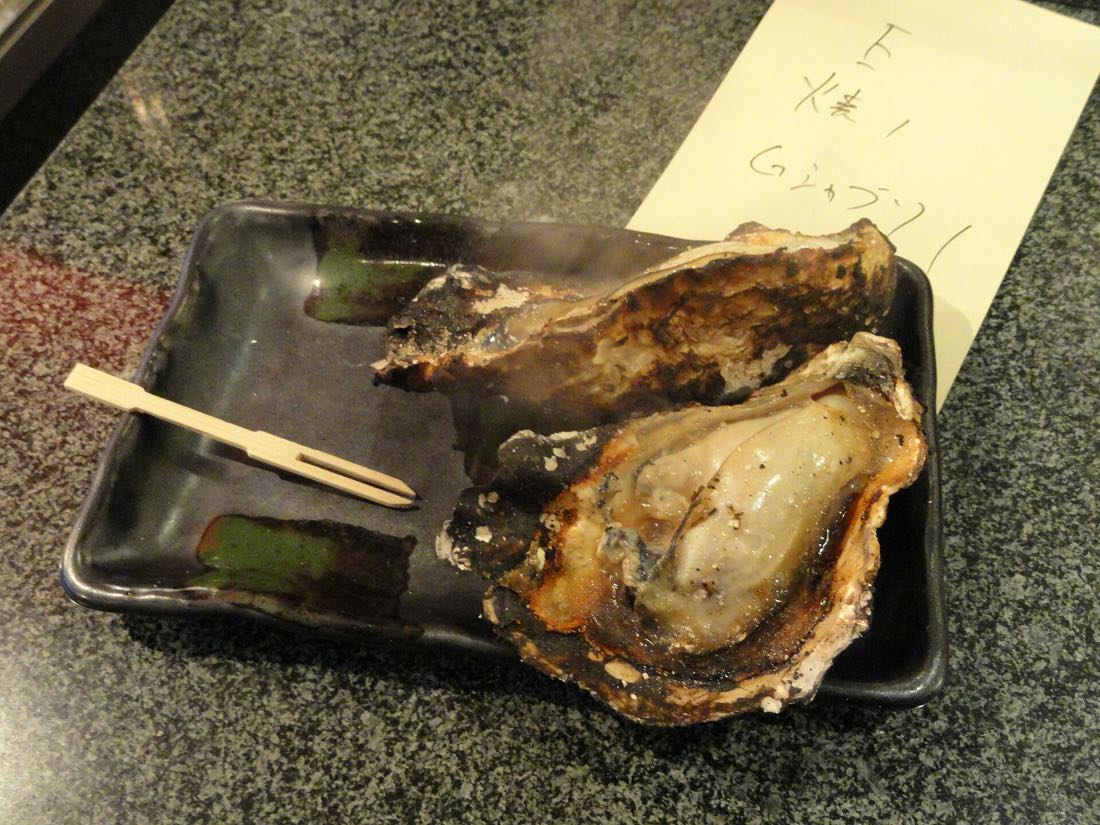
Hiroshima oysters are a
winter dish
— and it is August
Hiroshima grows the majority of Japan's oysters and the city sells that fact all year round. The season does not run all year round — and the festival almost every travel site still lists as an annual February fixture was cancelled in 2026 because there were not enough oysters.
Peak is December to February, with the broad season running roughly October to March. Grilled oysters at the Miyajima stalls run about ¥400–600 a pair and sit-down oyster sets sit in a ¥1,500–3,000 band. Summer is not a dead loss: non-spawning triploid natsu-kaki are a real product the prefecture's own tourism board promotes. 🔴 The Miyajima Oyster Festival was cancelled in February 2026 and no 2027 date is published — verify before planning around it.
The season, stated plainly
Answer firstHiroshima oysters are a winter dish — roughly October to March, peaking December to February. Come in July and you'll find the farmed summer Kaki Komachi variety and a lot of restaurants simply not doing oysters. The grilled-oyster stalls and the festivals are a November-to-March thing.
Hiroshima Prefecture produces the majority of Japan's farmed oysters — the rafts are visible from the Miyajima ferry, which is the single best piece of context you can get for free on this trip. That production is real and it is enormous. It is also seasonal, and the tourist-facing version of the city does not always say so.
The practical consequence: a December visitor and a July visitor to the same street are having two different trips. In December the grilled-oyster stalls on Miyajima's arcade are running, izakaya menus lead with oysters in five preparations, and Micchan's oyster okonomiyaki is on at ¥1,840. In July many of those same menus have no oyster line at all.
But do not overstate it. Hiroshima's own tourism board runs a dedicated feature on eating oysters here in summer, built around triploid natsu-kaki — a non-spawning summer oyster that stays edible through the warm months, sold alongside the farmed Kaki Komachi line. And Yakigaki no Hayashi, the landmark grilled-oyster shop on Miyajima, states that it keeps fresh oysters year-round. So the honest line is not "don't come in summer for oysters" — it is that the peak is a narrow 3 months and the rest is a smaller, more specialised version of the same thing.
When oysters are actually on
By monthThe bar is how likely you are to find oysters properly on the menu — not the weather. Peak is a narrow three months in the middle of winter.
The October–March window and the December–February peak are the shape every Hiroshima source agrees on; exact opening and closing weeks vary year to year and by producer. One warning sign for 2026–27: the February 2026 Miyajima Oyster Festival was cancelled because organisers could not secure enough oysters, which points to a weak 2025/26 harvest. Treat the shoulder months as maybes and the middle 3 as the certainty.
What you get, by month you arrive
Compared| If you arrive | What is on | Where to eat it | Verdict |
|---|---|---|---|
| Dec–Feb | Full season — grilled, fried, raw, hotpot, in miso | Miyajima arcade stalls, city izakaya, oyster okonomiyaki | WORTH IT |
| Oct–Nov | Season opening, stalls starting up | Miyajima and central Hiroshima izakaya | WORTH IT |
| March | Season closing but still widely on | Everywhere it was in February, thinning out | WORTH IT |
| Apr–May | Peak over; specialists continue | Specialist oyster restaurants; Yakigaki no Hayashi | DEPENDS |
| Jun–Sep | Triploid natsu-kaki and Kaki Komachi — real, but not on every menu | Specialist shops. Do not count on a random izakaya | DEPENDS |
The summer row is a DEPENDS, not a SKIP: summer oysters genuinely exist and Hiroshima's own tourism board promotes them, but they are a specialist purchase rather than something you stumble into. June to September is also when Hiroshima's other dishes earn their place — cold chilli tsukemen, which exists precisely because August averages 32.8°C, and okonomiyaki at ¥960, on all 12 months.
Summer oysters are real — this is the part nobody publishes
For summer visitorsIf you are here between roughly April and September and you do find oysters, they will be non-spawning summer stock: triploid natsu-kaki, and the farmed Kaki Komachi line. Non-spawning is the whole mechanism, because spawning is why the classic season ends — a spawning oyster puts its energy into reproduction and the meat goes thin and milky. Breed an oyster that does not spawn and the summer problem goes away.
This is not a workaround somebody invented for tourists. Hiroshima's official tourism board runs a dedicated feature on eating the prefecture's oysters in summer, and Yakigaki no Hayashi on Miyajima states that it keeps fresh oysters year-round. If a travel page tells you flatly that there are no oysters in Hiroshima in July, it has not checked.
What is still true: it is a specialist purchase, not a stall item. In February you trip over grilled oysters on the Omotesandō; in July you go to a shop that specifically does them. So the summer instruction is to pick your restaurant deliberately rather than to give up — and to build the rest of the eating around okonomiyaki at ¥960, anago-meshi at Miyajimaguchi and Saijō sake, all of which run every month.
If your dates are movable and oysters are a real motivation, move to December, January or February. That is also when Miyajima is quietest, which is a second argument for the same decision — see the best time to visit.
The Miyajima Oyster Festival was cancelled in 2026
Correction🔴 The 42nd Miyajima Oyster Festival, scheduled for 14–15 February 2026, did not take place. The organisers cancelled it because they could not secure enough oysters — the stated reason was poor oyster growth. No 2027 information has been published.
Nearly every travel site still lists this festival as an annual fixture on "the second weekend of February", and several itineraries are built around it. That is now wrong, and it is checkable. If a February oyster festival is the reason you are choosing your dates, confirm directly with the Miyajima Tourist Association on 0829-44-2011 before you book anything.
The cause matters beyond the festival. An event of that size being cancelled for lack of supply is a signal about the 2025/26 harvest generally — so if you are travelling in the 2026–27 season, treat availability and price as slightly less certain than the historical pattern suggests, and ask at the counter rather than assuming.
The rest of the winter offer is unaffected: the grilled-oyster stalls on the Omotesandō, the izakaya menus and the sit-down oyster restaurants all run through the season regardless of whether a festival takes place.
The five preparations worth ordering
In seasonGrilled in the shell (yaki-gaki)
The one to have first. Cooked over coals in the half shell on the street and eaten standing up, at roughly ¥400–600 a pair at the stalls. The landmark is Yakigaki no Hayashi, mid-Omotesandō about 8 minutes from the pier, founded 1948, which claims to have originated grilled oysters served to customers in Japan and uses 3-year-old Jigozen oysters. 10:30–17:00, last orders 16:30 — it shuts before the day-trippers' last ferries, so this is a lunch, not a dinner.
Kaki-fry — panko-fried oysters
Breadcrumbed and deep fried, served with shredded cabbage and tonkatsu sauce. The most reliably available restaurant preparation and the one children eat. Turns up as a lunch set as well as an izakaya plate, which makes it the easiest oyster to actually get into your day.
Kaki no dotenabe — miso hotpot
Oysters simmered in a pot lined with miso, with vegetables and tofu, at the table. This is the deep-winter version and it is a whole evening rather than a dish. Best in December to February, when it is genuinely cold enough in Hiroshima to want it.
Raw, with lemon
Available and good in the middle of the season. The caveat is a general one about raw shellfish rather than anything specific to Hiroshima: if you would not eat raw oysters at home, this trip is not the place to start. Ask whether they are certified for raw consumption — that is a normal question here, not a rude one.
Oyster okonomiyaki
In season, okonomiyaki counters add oysters as a build. Micchan Sōhonten's menu prices カキ入りそば肉玉子 at ¥1,840 against ¥960 for the standard — so the oysters roughly double the plate, and it is still one of the better-value ways to eat them in this city. Two Hiroshima signatures on one griddle. Closed Tuesdays, walk-in only.
Oyster experiences and the bike route
Book itIn season, the guided options put you in front of producers rather than menus. We do not publish tour prices, ratings or review counts — none could be verified for this build, and availability is itself seasonal.
The practical bit
Plan your visitOyster questions, answered
FAQPage schema pairedWhen is oyster season in Hiroshima?
Roughly October to March, with the peak from December to February. Those 3 middle months are the certainty; October and March are shoulder months that shift year to year and by producer. One caution for 2026–27: the February 2026 Miyajima festival was cancelled for lack of oysters, which suggests a weak recent harvest.
Can I eat oysters in Hiroshima in summer?
Yes — more than most guides admit. Non-spawning triploid natsu-kaki and the farmed Kaki Komachi line are sold through the warm months, Hiroshima's own tourism board runs a feature on eating oysters here in summer, and Yakigaki no Hayashi on Miyajima keeps fresh oysters year-round. The catch is that it becomes a specialist purchase in 1 or 2 shops rather than something on every menu.
Does Hiroshima really produce most of Japan's oysters?
Hiroshima Prefecture produces the majority of the national farmed crop — it is the single dominant producing region, by a wide margin. You can see the rafts from the deck on the 10-minute Miyajima ferry crossing, which is the cheapest context on the trip given the ferry is ¥200 each way.
Where are the grilled-oyster stalls?
The Omotesandō shopping street on Miyajima, walking up from the ferry terminal toward the shrine. The landmark shop is Yakigaki no Hayashi, about 8 minutes from the pier, open 10:30–17:00 with last orders at 16:30 — which means it closes before the evening, so treat it as lunch. More on the Miyajima food page.
How much do oysters cost in Hiroshima?
Grilled at a street stall, about ¥400–600 a pair (roughly $3–4). A sit-down oyster set sits in a ¥1,500–3,000 band — treat that as a band rather than a price, because oyster prices move with supply and the 2026 festival cancellation says supply has been tight. Oyster okonomiyaki at Micchan is ¥1,840. See the costs page.
Is the Miyajima Oyster Festival still running?
🔴 The 42nd festival, scheduled for 14–15 February 2026, was cancelled — the organisers could not secure enough oysters, citing poor growth. No 2027 information has been published. Almost every travel site still lists it as an annual second-weekend-of-February fixture, which is now wrong. Verify with the Miyajima Tourist Association on 0829-44-2011 before booking around it.
Are raw oysters safe in Hiroshima?
Raw oysters are widely served in season and Japan distinguishes between oysters certified for raw consumption and those for cooking. Ask which you are being served — it is a normal question. The 1 sensible rule: if raw shellfish is not something you eat at home, an unfamiliar country is not the place to try it.
Should I move my trip for the oysters?
If oysters are a real motivation, yes — move to December, January or February. You get the peak of the season, and Miyajima is at its quietest, which are 2 arguments for the same decision. If your dates are fixed in summer, do not build the trip around them. See the best time to visit.