Two days in Hiroshima,
and the tide picks day two.
Two days is the shape that works: the Peace Park and the ordinary city on day one, Miyajima on day two. The only real decision is what time your ferry leaves, and that is set by the tide table rather than by your alarm clock. Every stop below has a duration and every gap has a walking or riding time.
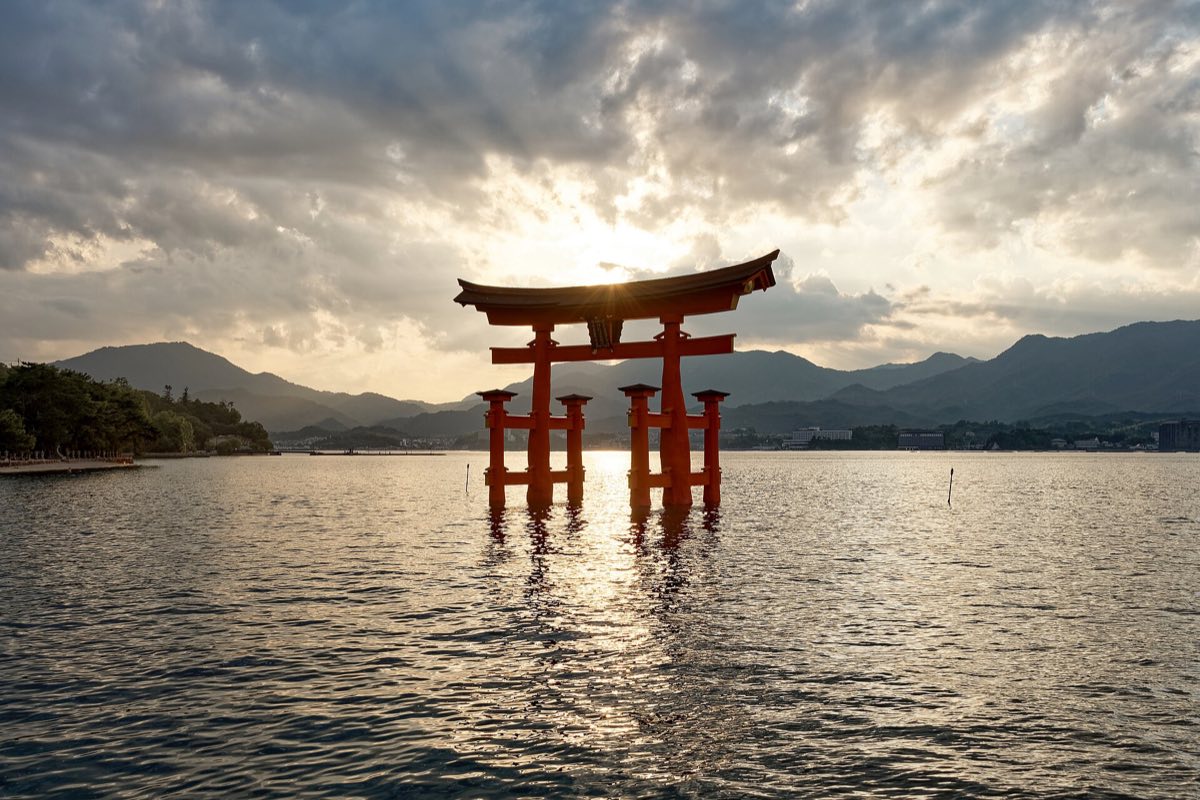
Day one: the Peace Park from the 7:30 museum opening, then the castle grounds, a garden and okonomiyaki. Day two: Miyajima, with the ferry timed to the tide — above roughly 250cm the Great Torii appears to float, below roughly 100cm you walk out to it, and the two states are about six hours apart. Budget about ¥4,750 (~$30.10) in admissions, ferries and trams across both days, plus one night in the city at roughly ¥9,500. Check the tide table before you book anything else.
Book day two around the tide, then fit day one to it
Read this firstThis is the one itinerary decision on the site that runs backwards. You do not pick a ferry time and hope; you look up the tide for your date, decide which of the two useful states you want, and build both days around that.
Miyajima runs on the tide, not the clock. Above 250cm the Great Torii appears to float and the shrine's corridors stand over water; below 100cm you can walk out across the sand to the gate's legs. Those are the Miyajima Tourist Association's own published thresholds, and they are measured against the Hiroshima Port datum — 200cm below mean sea level — so a generic tide app will give you numbers that look similar and are not comparable. Check the official table before you book the ferry, not after.
The 250cm and 100cm thresholds are not our rule of thumb — they are printed on the Miyajima Tourist Association's own tide table. But there is a trap underneath them that competing pages miss entirely: those figures are measured against the Hiroshima Port tidal datum, which sits 200.0cm below mean sea level. A generic tide app on a different datum returns numbers that look similar and are not comparable. Use the association's own tide page, which computes the float and walk windows for you, or JMA station Q8.
The band nobody warns you about is the flat middle. Between 100cm and 250cm you get wet sand with no reflection and a gate you cannot walk to — neither photograph, neither experience. Between 100 and about 120cm you can get close with wet feet; for dry shoes and a wide sand flat you want about 40cm or lower.
Here is the headline, and nobody else publishes it: the floating shrine is available essentially every day of the year. Walking to the torii is not. Across August to December 2026, 106 of 153 days allowed the walk — in November only 16 of 30. Floating averages about seven hours a day; walking averages 2.4 hours in August, about 1.1 in November, and is frequently zero. Neap tides kill the walk and never kill the float. 🔴 There are dead stretches: from 20 to 24 August 2026 the tide never drops below 100cm at any hour, so a visitor arriving on 21 August cannot walk to the gate at all.
The upshot for a two-day plan is better than the usual advice: on many dates you can have both — on 25 of 30 August days and 16 of 30 November days both thresholds were crossed in daylight. Check your date on our tide page before you book the ferry, and if only one state is available, take the float.
Peace Park and the city, timed
Day onePeace Memorial Museum, at opening
¥200 (~$1.27). The 7:30–8:30 slot is online-reservation-only all year, released 90 days ahead — Asoview domestically, Klook from overseas — and capped at roughly 300 people per 30 minutes. Two hours is the floor. Hiroden line 2 or 6 to Genbaku Dome-mae, ~15 minutes from the station at the flat ¥240 fare, then a 7-minute walk. Full detail on the museum page.
National Peace Memorial Hall
Free, three minutes' walk, underground and near-silent. Most two-day plans skip it and should not. What is inside.
Cenotaph, Flame, Children's Peace Monument, Dome
All free and always open, about 17 minutes of walking end to end. Crane booths 08:45–17:00. You leave the park at 11:20, just as the 11:00–14:00 block fills. See the full circuit.
Lunch in the arcade
Ten to twelve minutes on foot to the Hondori end. Cold tsukemen or a ramen counter — okonomiyaki is tonight. Restaurant prices are not verified on this site.
The 13:00 English testimony talk
Museum East Building, Basement 1: 13:00–14:00, free, in English, daily, no booking, delivered by a trained legacy successor. There is nothing else like it in Japan and almost nobody publishes it. How it works.
Hiroshima Castle grounds
Free, 9:00–17:30 (16:30 Oct–Mar), 18–20 minutes' walk north. The keep is shut — go for the moat, the bomb-scarred walls and Ninomaru. The castle page.
Shukkeien Garden
¥350, twelve minutes east of the castle or one stop on Hiroden line 9 to Shukkeien-mae. A survivor ginkgo still stands in it. More.
Hatchobori, Hondori, then okonomiyaki
The best-connected tram position in the city and the covered arcade if it rains. Eat at a standalone counter — Nagataya, Micchan or Hassei — rather than assuming Okonomimura is the only option. The area, explained.
The Dome after dark
Line 2 or 6 back, ¥240, ~8 minutes. Floodlit, unfenced, unstaffed, and the best 30 minutes of the day. Then sleep in the city — you have a ferry to catch.
Miyajima, in the two versions the tide allows
Day twoLook up your date, find which of the two useful states falls in daylight, and take the matching column. The middle band is not a plan, it is a warning.
| Time | If the high tide is in the MORNING | If the high tide is in the AFTERNOON |
|---|---|---|
| 08:00 | Leave the city. JR Sanyo line to Miyajimaguchi, ¥420 and 27 minutes — free on a JR Pass. | Leave the city on the same 30-minute run — an early start still beats the day-trip coaches. |
| 08:40 | Ferry across, 10 minutes. ¥200 each way, plus the ¥100 visitor tax on the outbound leg only. JR sailings leaving Miyajimaguchi between 09:10 and 16:10 detour close past the Great Torii at no extra charge, outbound only — so take JR out inside that window and whichever boat is next coming back. | Same crossing, same detour window. Matsudai is the identical ¥200 but does not detour and is not covered by the JR Pass. |
| 09:00–10:30 | Itsukushima Shrine at high water — ¥300 adult, ¥500 with the Treasure Hall. The corridors stand over the sea and the gate floats. The shrine opens at 06:30 and the first ferry crowds do not land until about 09:00, so if you slept on the island this is already over. | Ropeway up Mt Misen — ¥1,100 one way, ¥2,000 return. Empty at this hour. |
| 10:30–12:30 | Ropeway to Shishiiwa, then about an hour on foot round trip — 30 minutes of steep rock each way — to the actual summit. The ropeway does not go to the top and most listings do not say so. Reifudo burned down on 20 May 2026 and there is a detour near the summit; do not plan on seeing the eternal flame. | Come down on foot via Momijidani (~2h) or Daishoin (~90 min) instead of paying the return fare. The three routes. |
| 12:30–14:00 | Lunch: anago-meshi or oysters, then Daishoin temple — the island's most underrated 45 minutes and free. | Lunch, then the shrine as the water comes back in. Closing is 17:00–18:00 seasonally, so do not leave it later than this. |
| 14:00–16:00 | The tide is dropping. Walk out to the gate's legs across the sand if it clears 100cm, or take Omotesando and the back lanes. | Itsukushima Shrine at high water, ¥300, plus the walk along the front while the gate floats. |
| 16:00–17:00 | Last ropeway descent is 16:30. Miss it and it is 75+ minutes on foot in failing light. | Last shrine entry has passed — the illuminated exterior is still free and still worth the wait. |
| From 17:00 | Ferry back to the city, or stay. The island after the last ferry is a different place entirely. | Same call. If you booked a room here, this is the hour it pays for itself. |
Admissions and ferry fares checked 4 August 2026. The 250cm and 100cm thresholds are printed on the Miyajima Tourist Association's own tide table — but they are measured against the Hiroshima Port datum, so a generic tide app is not comparable. The Reifudō hall on Mount Misen burned down on 20 May 2026, and with it the shelter of the 1,200-year 「消えずの火」 — the flame said to have been lit by Kūkai, and the source flame for the Peace Park's Flame of Peace. Nobody was hurt and the mountain did not burn. The trails and the ropeway are open, but there is a detour near the summit, the temple has announced no rebuilding plan, and it has not said whether the flame itself survived. Almost every English guide still tells you to go and see it. Dollar prices convert at ¥157.7 = $1, the rate on 4 August 2026. Treat every $ figure as a snapshot and the ¥ figure as the real price.
Every route to Miyajima, priced and timed
Getting to the islandThree ways off the mainland and one fee that catches rail-pass holders every single day.
| Route | Time | Fare | Verdict |
|---|---|---|---|
| JR Sanyo line, Hiroshima Station to Miyajimaguchi | 27 min | ¥420 — free with the JR Pass, the Setouchi pass or the ¥17,000 Kansai–Hiroshima Area Pass | WORTH IT |
| Hiroden line 2 all the way to Miyajimaguchi | ~65–75 min | ¥240 flat — and the February 2025 revision cut this run from ¥270, so it is the one fare in the city that got cheaper | DEPENDS |
| JR West ferry, Miyajimaguchi to the island | 10 min | ¥200 each way · ¥300 with the visitor tax · ¥500 return with tax. Covered by the JR Pass. Sailings out of Miyajimaguchi 09:10–16:10 detour past the torii; last boat off the island 22:14 | WORTH IT |
| Miyajima Matsudai ferry | 10 min | ¥200 each way — identical price, no torii detour, not covered by the JR Pass but covered by Hiroden passes | DEPENDS |
| Miyajima visitor tax | — | ¥100 per person, charged on the outbound leg only. The ¥500 annual pass needs in-person registration and only breaks even at five visits — just pay the ¥100 | SKIP |
The trap: a rail pass covers the JR ferry but not the ¥100 visitor tax, so pass holders still buy a separate tax ticket at the terminal. Details on the tax page and every route on getting to Miyajima.
Should day two become an overnight?
The upgradeIf you only have two days, no — day-trip the island and do not feel short-changed. The overnight case is real, but it belongs to a three-day trip, because it costs you the second half of day one.
Miyajima between 10:00 and 15:00 is a queue with an island attached. The last ferries take the crowds away and take the open shops with them, so a 16:00 arrival gets you an island with nothing on it. The torii lit after dark, and the deer in empty streets, are only available if you sleep there.
The argument is easier to make from a closing-time list than from atmosphere. Momijido Kaigan-dori shuts at 16:00 · Senjokaku 16:30 · the aquarium's last admission 16:00 · the ropeway's last descent 16:30 · Yakigaki no Hayashi 17:00 · the Treasure Hall 17:00 · Daishoin 17:00 · Itsukushima Shrine 18:00. The island's entire commercial and religious apparatus closes between 16:00 and 18:00 — which means a day-tripper's Miyajima is, by definition, the window when it is busiest. The honest caveat that makes the case credible: the last JR ferry is 22:14, so you can see the lit torii and still leave. What you cannot buy at any price is the 06:30 morning, when the shrine opens and the first crowds are still 2.5 hours away.
Two things to know before you plan the island around a photograph. Illumination comes on 30 minutes after sunset and goes off at 23:00 year-round — and you cannot enter the shrine during it. It is a view from outside, from the Omotesando shore, Mikasanohama or a boat; any article implying an evening stroll through the corridors is wrong. And:
Miyajima's five-storey pagoda has been fully sheeted for preservation work since January 2025 and stays that way into at least 2027. It is not visible from anywhere on the island. Every photograph you have seen of it is pre-2025 — plan the shot you actually can take instead.
If you stay over, eat and shop before 17:00 — there is very little food afterwards and your ryokan dinner may be the only option. The island's inventory is ryokan with two meals rather than hotels, which is why the cheapest bed on Miyajima runs roughly twice a mainland business hotel, and why it sells out early — there are very few rooms. On a two-day trip the arithmetic does not work: you would be checking out of the city on the morning of day one with luggage, or paying for two beds on the same night. On a three-day trip it works beautifully. The full comparison is on day trip versus overnight, and the rooms are on where to stay on the island.
Hiroshima is a comfortable, well-run, entirely ordinary mid-size Japanese city. The bomb took the old fabric and the rebuild was practical rather than picturesque. Come for the Peace Park, the island and the food — not for the streetscapes. The mistake almost everyone makes is giving the important part four hours and the ordinary part none.
Two days in Hiroshima — the questions people ask
FAQPage schema pairedIs 2 days in Hiroshima enough?
Yes — it is the shape most visitors should book, at about ¥4,750 per adult in admissions and transport across the 2 days. It covers the Peace Park with the museum's 90-minute-to-2-hour floor intact, plus a full day on Miyajima timed to the tide. What it does not cover is the ordinary city, Kure, Onomichi or Saijo, which is what the third day buys.
Can you do Hiroshima and Miyajima in one day?
You can, and it costs you the museum. The island round trip absorbs about five hours before you have looked at anything — 27 minutes each way on the JR Sanyo line, a 10-minute ¥200 ferry plus the ¥100 tax, and a three-hour minimum on the island. Two days removes that compromise entirely.
What time should I go to Miyajima?
Whichever ferry puts you at the shrine within the tide band you want — above roughly 250cm for the floating gate, below roughly 100cm to walk out to it. The two are about six hours apart. Failing that, be on the 08:40 crossing: between 10:00 and 15:00 the island is a queue with an island attached.
How much does a 2-day Hiroshima trip cost?
About ¥4,750 (~$30.10) per adult in admissions and transport: ¥200 museum, ¥350 Shukkeien, ¥300 Itsukushima Shrine, ¥2,000 ropeway return or ¥1,100 one way, ¥500 return ferry with tax, and two ¥700 tram day passes. Add roughly ¥9,500 a night for a business 3-star, and note that Hiroshima Prefecture adds a ¥200 per person per night prefectural accommodation tax you pay at the desk.
Should I stay in Hiroshima or on Miyajima?
On a two-day trip, stay in the city both nights — a Miyajima room runs roughly ¥19,000 against about ¥9,500 on the mainland, and would strand your luggage. On a three-day trip, put one night on the island; the torii lit after dark and the deer in empty streets are only available to people who sleep there.
Is the Miyajima ropeway worth ¥2,000?
Ride up one way at ¥1,100 and walk down. The ropeway drops you at Shishiiwa, not the summit — the real top is another 30 minutes of steep rock each way — and the last descent is 16:30, after which it is 75+ minutes on foot. The one-way fare saves ¥830 and removes the deadline.
What is the best order for two days in Hiroshima?
Park first, island second. The museum's 7:30 opening only exists on a day you start in the city, and doing the island on day two lets you shift the ferry by up to six hours to catch the tide without touching anything else in the plan.
Do I need a JR Pass for two days in Hiroshima?
No. A national 7-day pass is ¥50,000, rising to ¥53,000 on 1 October 2026, and two days here will not come close to justifying it. If you are travelling the wider region, the JR Setouchi Area Pass at ¥22,000 is usually the right answer — the maths is on the pass comparison.
The two-day trip, booked
Book itOne night in the city, and a guided option for whichever of the two days you would rather not navigate yourself.