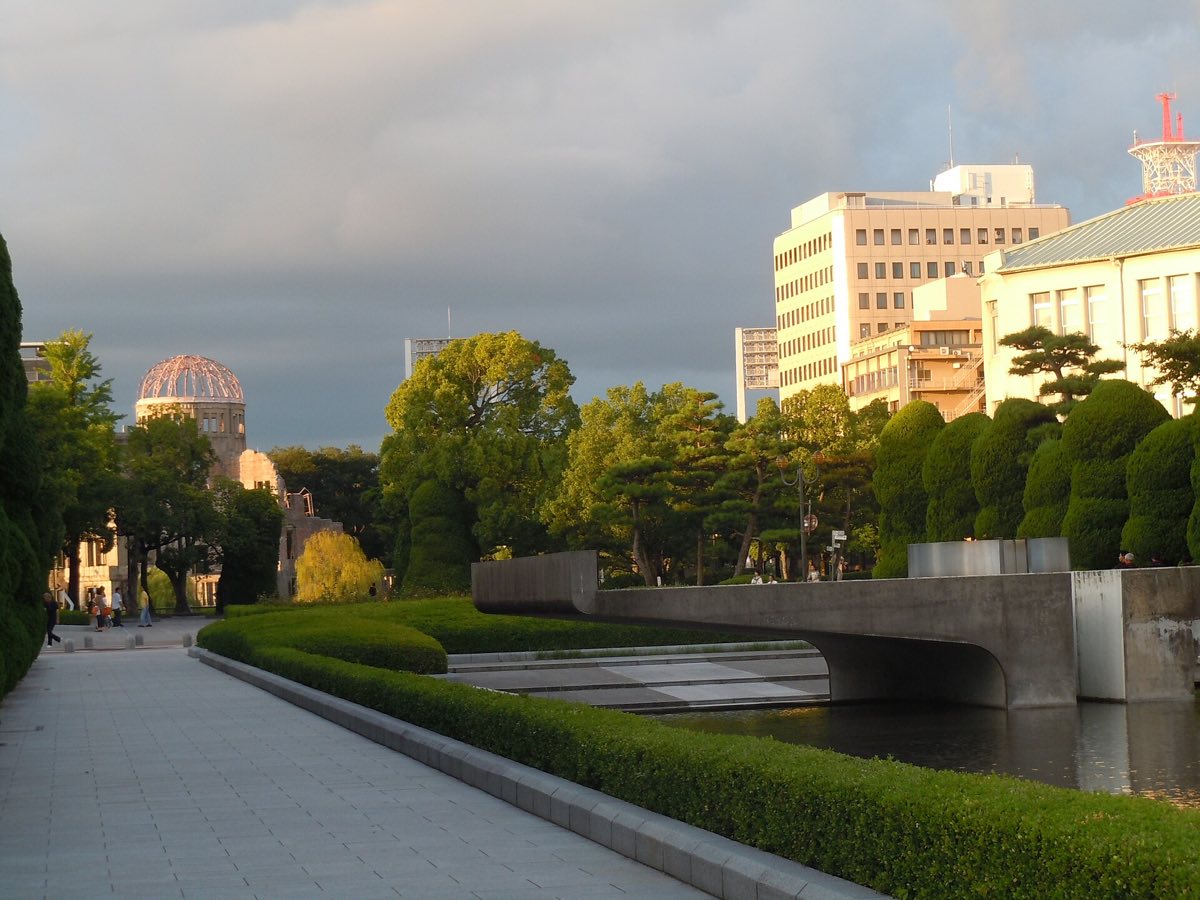
There is one posted rule
and a great many norms.
Most pages about behaviour in Hiroshima are written in a register of anxious piety and get the actual rules wrong. The whole Peace Memorial Park is non-smoking and that is the only hard prohibition posted anywhere. Photography inside the museum is permitted. Everything else is a norm — which is a stronger constraint, and a harder one to look up.
One posted rule: the entire Peace Memorial Park is non-smoking. There is no published dress code, no eating ban, no enforced silence and — despite what half the internet says — no photography ban inside the Peace Memorial Museum. Cameras and phones are permitted without flash for personal use; no tripods, no selfie sticks, no phone calls in the exhibition rooms, no large bags. What governs behaviour here is not regulation but norm, and the gap between what is permitted and what is done is the single most useful thing to understand before you arrive.
What is posted, and what is only expected
The actual rulesThe cards marked in accent are hard rules with a sign behind them. The rest are norms — no one will stop you, and that is precisely the point.
This is the only hard posted prohibition covering the park, and it covers all of it — not designated zones inside a smoking park, the whole triangle between the two rivers. There is no published code of conduct beyond it, which is itself worth saying out loud.
The only posted rule in the parkWithout flash, for personal use, throughout the building. Most blogs get this wrong in the direction of excessive caution. There is no gallery-specific ban either — the rule is uniform, including the Main Building where the tricycle, the school uniform and the donated skin and hair are. Nothing stops you photographing that room. Almost nobody does, and it is silent. That gap is the honest editorial point: it is a norm, not a rule.
No tripods, no selfie sticks, no phone calls in the galleriesLockers are on the first floor of the museum's East Building and large bags are not admitted to the exhibition. Eating and drinking are confined to the 1F Visitor's Lounge. Commercial and press filming needs a written application to the museum in advance.
Lockers, 1F East BuildingWhen the Chugoku Shimbun's Peace Media Center asked 50 people at the A-Bomb Dome, 70% said seeing visitors flash peace signs there made them uncomfortable; 24% saw no problem. The failure mode is thoughtlessness rather than malice — one defender's own explanation was that the Dome is "a 'tourist spot' … so I posed in front of it as I always do, without thinking." Peace educator Seiji Horie explicitly opposed banning it: forcing people not to, he argued, would not make them think more deeply. So: nobody will stop you, and a large majority of the people standing next to you will wish you hadn't.
70% of 50 people surveyedThe city's own visitor portal is branded Peace Tourism. The other term is an outsider academic label that Hiroshima has visibly declined, and the useful test — from Prof. Hideki Endo of Ritsumeikan University — is that a place only qualifies if people "miss, grieve and pray for" the victims, which is exactly the test a ranked listicle fails. Use the city's word.
The city's word is Peace TourismAnyone may offer folded cranes at the Children's Peace Monument, freely, with no registration and no form. They go in the dedicated booths around the monument, not on the statue itself. Cranes can also be posted to the city, and offered cranes are not discarded — the city passes them to groups who repurpose them.
Booths 08:45–17:00 daily · 06:00–20:00 on 6 August"Let all the souls here rest in peace, for we shall not repeat the evil" has no grammatical subject in Japanese, and who "we" means has been contested for seventy years. The city's official position is that it is a pledge by all people never to repeat the error that is war, not an admission by any one nation. In 2005 a man attacked the stone with a hammer and chisel because he objected to the word "error", and it had to be replaced. Explain it; do not flatten it.
Contested since 1952Bag check at the park entrance and a metal detector at the seating entrance. Banned: blades, flammables, megaphones and loudspeakers, musical instruments, placards and banners, drones, helmets and headbands. The park is closed to the public 05:00–09:00 and attendees may enter from 06:00. The full hour-by-hour is here.
Bag check and metal detectorFeeding has been banned since 2008 and the deer have adapted by eating maps, tickets and guidebooks. They are not aggressive; they are hungry. Keep your ¥200 ferry ticket and your ¥100 visitor tax slip inside a bag, not in an outside pocket, and do not offer food to prove a point.
No feeding since 2008Shoes off where there is a step and a rack. Queue at the marked positions on the platform. No tipping anywhere, including guides and taxi drivers. Keep phone calls off the ¥240 trams. Rubbish bins are scarce — carry it until you find one. None of this is Hiroshima-specific and all of it is noticed.
No tipping, anywhereIs it awkward to visit Hiroshima as an American?
The question people are afraid to typeNo. And we are going to answer this once, directly, rather than gesturing at it — because it is asked constantly and answered evasively everywhere else.
The line Hiroshima's own peace guides use, and the honest answer, is this: "It's not America we hate. What we hate is war." That is not a diplomatic formula invented for tourists. It is the settled position of the institutions that exist here — the museum, the Memorial Hall, the volunteer interpreters — and it is the frame the city has chosen for itself. Nobody at the Cenotaph is going to ask where you are from, and nobody is keeping a ledger.
Now the caveat, because the comfortable version on its own would be dishonest. If Japanese people did feel resentment, they would be far too polite to show it. Politeness here is not the same as absence of feeling, and you cannot read the absence of hostility as proof of anything. Some visitors want a page that tells them they are definitely fine. We are not going to sell you that. What we can tell you is that the institutional position is unambiguous, that 945,618 foreign visitors — 36.6% of 2,580,926 admissions — went through the museum in FY2025, and that whatever discomfort you feel walking around will be yours and not something the city is directing at you.
The practical version: go, take the museum seriously, allow it more than the four hours everyone gives the whole city, and do not perform. Sit in on the free 13:00 English testimony talk if you can — 60 minutes, no booking, East Building Basement 1. It will do more for the question you are actually asking than any reassurance a travel page can offer.
We don't put a verdict badge on the Peace Memorial Museum, the Park, the Dome or the Cenotaph. They aren't purchases to be assessed, and ¥200 against 140,000 dead isn't a value calculation. Where a guided tour of them is worth the money we say so about the tour, not about the place.
Is Hiroshima still radioactive?
The other question people are afraid to typeNo. Hiroshima has ordinary background radiation and has been continuously lived in since 1945. You are not taking a risk by visiting, staying overnight, eating the oysters or drinking the water.
The bomb was detonated in the air, several hundred metres above the city, rather than at ground level. That is why the destruction was so wide and why residual ground contamination was comparatively short-lived: the fireball never touched the earth in the way a ground burst does. Levels fell to background within a period measured in years, not centuries, and people rebuilt and lived in the city throughout.
The concrete proof is standing and open to the public. The former Teishin Hospital outpatient wing, a 1935 building 1,370 metres from the hypocentre, took the blast, became one of the few working relief stations afterwards, and reopened on 1 May 2026 as a free museum you can walk into, 9:00–17:00, closed Mondays. The A-Bomb Dome has stood in the open since 1945. The Peace Memorial Park is a park people jog through.
What has not gone away is the human cost. There are roughly 91,000 hibakusha nationwide with an average age of 86.66, and against about 32 living survivor testifiers the city now trains denshosha — legacy successors — to carry individual testimonies forward; as of 1 April 2026 there were 264 legacy successors and 48 family successors. That is the enduring consequence, and it is a human one, not an environmental one.
Hiroshima rules and etiquette — the questions people ask
FAQPage schema pairedCan you take photos in the Hiroshima Peace Memorial Museum?
Yes. Photography and video are allowed inside, without flash, for personal use, and the rule is uniform across the building — there is no gallery-specific ban, including the Main Building rooms. No tripods, no selfie sticks, no phone calls in the exhibition, and large bags go in the lockers on the 1F of the East Building. Commercial or press filming needs a written application.
What are the rules in Hiroshima Peace Memorial Park?
One: the entire park is non-smoking. There is no published dress code, no ban on eating, no photography restriction and no enforced silence — and there is no published code of conduct at all beyond the smoking rule. On 6 August specifically there is a bag check at the park entrance and a metal detector at the seating entrance, with drones, banners and megaphones banned.
Is it disrespectful to take a peace sign photo at the A-Bomb Dome?
Nobody will stop you, and most people around you will wish you hadn't. When the Chugoku Shimbun asked 50 people at the Dome, 70% said it made them uncomfortable and 24% saw no problem. Peace educator Seiji Horie opposed banning the gesture on the grounds that a ban would not make anyone think harder — so this is a decision, not a regulation.
Is it awkward to visit Hiroshima as an American?
No. The line Hiroshima's own peace guides use is "It's not America we hate. What we hate is war," and 945,618 foreign visitors — 36.6% of the museum's 2,580,926 FY2025 admissions — went through the building last year. The honest caveat is that if Japanese people did feel resentment they would be far too polite to show it, so take the institutional position as real and do not read politeness as proof.
Is Hiroshima still radioactive?
No. The bomb was an air burst several hundred metres up, residual contamination fell to background levels within years rather than centuries, and the city has been lived in continuously since 1945. The Teishin Hospital building 1,370 metres from the hypocentre reopened as a free public museum on 1 May 2026 — you can walk into it, 9:00–17:00, closed Mondays.
Should I call visiting Hiroshima dark tourism?
No — use the city's own word, which is Peace Tourism. That is how Hiroshima brands its own visitor portal, and the other term is an outsider academic label it has visibly declined. The useful test, from Prof. Hideki Endo of Ritsumeikan University, is whether people "miss, grieve and pray for" the victims, which a ranked list plainly fails. For scale, 2,580,926 people went through the museum in FY2025 and 945,618 of them were foreign visitors.
Can anyone leave paper cranes at the Children's Peace Monument?
Yes, freely, with no registration and no paperwork. They go in the dedicated booths around the monument rather than on the statue, and the booths are open 08:45–17:00 daily, extending to 06:00–20:00 on 6 August. Cranes can also be posted to the city, and offered cranes are never discarded — the city passes them to groups who repurpose them.
What should I wear to the Peace Memorial Park?
Whatever you would wear to walk 1.2km in the open. There is no dress code posted anywhere in the park. If your visit falls in August, dress for a daily maximum of 32.8°C at 69% humidity — the ceremony morning means standing outdoors from 06:00, and that is the constraint that actually matters.
Booking and getting there
PracticalNothing in the park has to be booked and nothing outdoors costs money. These are guided walks, for people who would rather have the context spoken than read — and where we badge anything, we badge the tour, never the place.