Naka-ku,
the walkable half.
Naka-ku is the ward the rebuild put the city's civic life into: the Peace Memorial Park, six river frontages, the castle grounds, two art museums and the arcades. Almost everything a visitor does in Hiroshima happens inside it, and most of it is within a twenty-minute walk of everything else.
Naka-ku is the central ward, bounded by the Motoyasu, Honkawa and Kyobashi rivers, and it contains the Peace Memorial Park, Hiroshima Castle's grounds, Shukkeien, Hondori and Hatchobori. Staying here means walking to the museum for its 7:30 opening instead of catching a tram, and being on the riverbanks at dusk. It is measurably quieter after 21:00 than Hatchobori, which is two or three streets east and is where the bars are. Hiroden lines 1, 2, 3, 6 and 9 all cross it at a flat ¥240, and a room runs around ¥9,500 plus a ¥200 per person per night prefectural accommodation tax you pay at the desk.
The ward the city was rebuilt around
What it isNaka-ku means, straightforwardly, the middle ward. It sits on the delta between the Honkawa, Motoyasu and Kyobashi rivers, and it is where the 1949 reconstruction plan put the park, the government offices, the shopping streets and the parade ground that became Peace Boulevard.
Hiroshima is a comfortable, well-run, entirely ordinary mid-size Japanese city. The bomb took the old fabric and the rebuild was practical rather than picturesque. Come for the Peace Park, the island and the food — not for the streetscapes. The mistake almost everyone makes is giving the important part four hours and the ordinary part none.
For a visitor the useful fact is compactness. From the A-Bomb Dome it is roughly 6 minutes' walk to the Children's Peace Monument, 10 minutes to the Cenotaph and the museum, 18–20 minutes north to the castle grounds, 10–12 minutes east to the Hondori arcade and about 25 minutes to Shukkeien. Nothing in that list involves a gradient. If you stay in Naka-ku you may not need a tram at all, which is the one argument against buying the ¥700 day pass.
The ward's second asset is the rivers. Six of them cross the city and the banks are open, planted and walkable, with cafés and boat piers at intervals. In summer the riverside is where Hiroshima actually sits outdoors, and in a city with no old streetscape left it is the closest thing to a set piece.
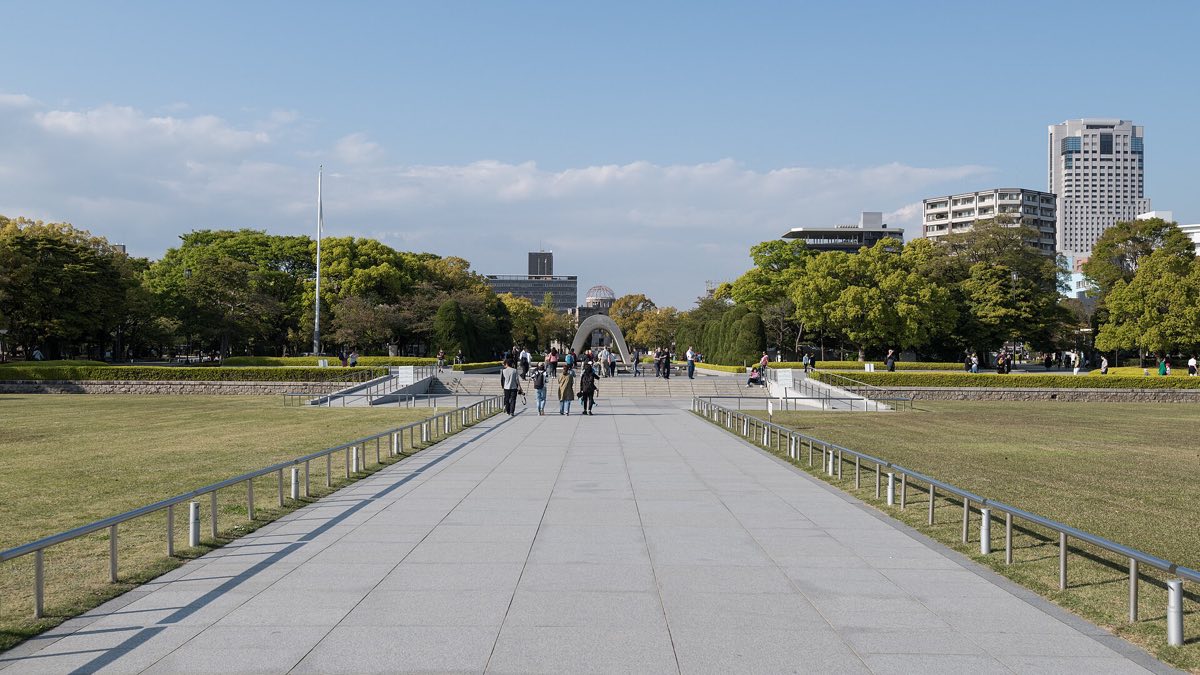
The Peace Memorial Park sits inside this ward
The memorial partThe park occupies the triangle of reclaimed ground at the fork of the Motoyasu and the Honkawa — the old Nakajima district, which was the busiest commercial quarter in the city until 8:15 on 6 August 1945.
Everything outdoors is free and open at every hour: the Cenotaph, the Flame of Peace, the Children's Peace Monument and the A-Bomb Dome. The Peace Memorial Museum is ¥200 for an adult, ¥100 for high-school students and over-65s with a passport, and free for junior high and under; the National Peace Memorial Hall is free. The whole park is non-smoking, which is the only hard posted rule there is.
Allow two hours in the Peace Memorial Museum, three if you read properly, and leave the two hours after it empty. At peak you don't walk the exhibition so much as get carried through it — during Obon last year staff had to stop admissions entirely. Everyone who budgeted 45 minutes regrets it.
The practical reason to sleep in this ward rather than by the station is the museum's 7:30 opening. That slot is online-reservation-only all year and capped at about 300 people per 30 minutes, and being ten minutes' walk from the door rather than a tram ride away is what makes an early booking easy to keep. The full layout is on the park page, the museum on its own, and what people actually do there on conduct and photography.
Naka-ku also holds the museum's newest auxiliary facility, which almost nothing else covers: the former Teishin Hospital outpatient wing, opened 1 May 2026 at Higashi-Hakushima-cho, about 1.5–2km north-east of the park. Free, 9:00–17:00, closed Mondays, no reservation, Hiroden Hakushima line to Katei-Saibansho-mae and two minutes on foot.
Walking times across Naka-ku
On footFlat paved ground throughout, measured at a normal pace. This table is the reason a Naka-ku bed does not need a transport budget.
| From | To | On foot | Cost when you arrive |
|---|---|---|---|
| A-Bomb Dome | Peace Memorial Museum | 7 min | ¥200 adult · free under 15 |
| A-Bomb Dome | Orizuru Tower | 1 min | ¥2,200 + ¥100 crane fee · 10:00–18:00, last entry 17:30 |
| Peace Memorial Park | Hondori arcade | 10–12 min | Free — it is a shopping street |
| Hondori | Hatchobori | 5 min | Free · tram interchange for lines 1, 2, 6, 9 |
| Peace Memorial Park | Hiroshima Castle grounds | 18–20 min | Free — the keep is closed. Hokoku Shrine ¥100 |
| Hiroshima Castle | Shukkeien Garden | 12 min | ¥350 |
| Shukkeien | Hiroshima Museum of Art | 8 min | ¥2,500 — one ticket, special exhibition and collection |
| Peace Memorial Park | Hiroshima Station | 45–50 min | Take the tram instead: line 2 or 6, ~15 min, ¥240 |
Hiroshima Castle's keep closed to the public on 22 March 2026 — after 68 years — because the 1958 reinforced-concrete reconstruction no longer met earthquake standards. A wooden rebuild is planned but years out. The grounds, the moat, the bomb-scarred stone walls and the Ninomaru reconstruction are all still open, and all still free. The tower you came to go inside is not.
The practical bit
Plan your visitQuieter than Hatchobori, and that is the trade
After darkNaka-ku is a large ward and the western half of it — the park side, the river frontages, the streets behind Peace Boulevard — goes quiet early. Kitchens stop taking orders sooner than in the entertainment district, and on a Sunday the blocks around the park are close to empty by 21:00. That is not a complaint; it is why people who want to be at the museum at 7:30 choose it.
The compensating attraction is the one thing in this city that is genuinely better at night. The A-Bomb Dome is floodlit, the park is unfenced and unstaffed, and thirty minutes there after dark reads completely differently from the same thirty minutes at noon. It costs nothing and it is a ten-minute walk from most Naka-ku beds.
If you want a bar afterwards, Nagarekawa and the Hondori arcade are five to ten minutes east on foot — near enough that the choice between wards is smaller than it looks. Hiroshima after dark covers what is actually open.
Naka-ku — the questions people ask
FAQPage schema pairedIs Naka-ku a good place to stay in Hiroshima?
Yes, and it is the best base if the Peace Park is why you came. From most Naka-ku hotels the museum is a 10–15 minute walk, which makes the 7:30 reservation-only opening slot genuinely easy to keep. Rooms run around ¥9,500 for a business 3-star and Hiroshima Prefecture adds a ¥200 per person per night prefectural accommodation tax you pay at the desk.
What is there to do in Naka-ku?
The Peace Memorial Park and museum, the A-Bomb Dome, Hiroshima Castle's grounds, Shukkeien Garden at ¥350, two art museums, the Hondori arcade and six river frontages. Only the museum, Shukkeien and the galleries charge admission — the rest of that list is free, and the park never closes.
Is Naka-ku walkable?
Almost entirely. The Dome to the museum is 7 minutes, the park to Hondori is 10–12, the park to the castle grounds is 18–20 and the castle to Shukkeien is 12 — all flat paved ground with no gradients. A Naka-ku stay is the one case where the ¥700 tram day pass is usually not worth buying.
Naka-ku or Hatchobori — which is better?
They overlap; Hatchobori is a district inside the wider central area and sits about five minutes east of Hondori. Take the park side of Naka-ku for early museum starts and river walks, and Hatchobori for shopping, eating and the best tram interchange in the city. The two are about 10 minutes apart on foot, or 1 stop at the flat ¥240 fare.
How do you get to Naka-ku from Hiroshima Station?
Hiroden line 2 or 6 to Genbaku Dome-mae for the park end, about 15 minutes at the flat ¥240 fare, or line 1 or 9 for the Hatchobori and Shukkeien side. The Meipuru-pu loop bus takes about 17 minutes and is free if you hold a JR Pass.
Is Naka-ku safe at night?
Yes, in the ordinary Japanese sense — the practical issue is that it is quiet rather than that it is risky. Kitchens in the park-side blocks stop serving earlier than in the entertainment district, so plan dinner before 21:00 or walk the ten minutes to Nagarekawa.
Where is the A-Bomb Dome in Hiroshima?
In Naka-ku, on the north edge of the Peace Memorial Park at the Aioi bridge, with its own tram stop — Genbaku Dome-mae on Hiroden lines 2 and 6, about 15 minutes and ¥240 from the station. It is exterior-only, free, floodlit after dark and open at every hour.
Is there anything in Naka-ku besides the Peace Park?
Yes — the castle grounds and their bomb-scarred stone walls, Shukkeien at ¥350 with its surviving ginkgo, the Museum of Art, the Hondori arcade, the riverbanks and the newly opened Teishin Hospital annex, which is free, 9:00–17:00 and closed Mondays. That list is roughly a full second day.
Booking and getting there
PracticalNothing outdoors in this ward needs booking and most of it costs nothing. These are the hotel search and two guided walks for people who want the connective tissue spoken rather than read.